
The Forager and the Wasp
What a jam jamboree!

The woman stands in an alleyway, or rather, in the impression of an alleyway, as conveyed by panes of color. Her robes are loose, somewhat masculine, and embroidered with a spray of vines. A pale hand beckons you. It moves like a white fish in shadowed water. She is very beautiful, in spite of, or because of, an aspect of mercantile cunning. The color of her hair is indistinct. It seems to say, “I do not matter. See my wares.” You approach. She will show you her wares.
She sweeps open her haori and gestures toward the lining. Her treasures are, for an instant, invisible—in error, you look to the space the coat surrounds, and not the coat itself. And then, there they are, shining! Sewn into the silk innards of her dress: berries, ripe, red and black, suspended in a grid. Like cards, divorced of all meaning but their suits; and the suits likewise alien: splined, palmate, conical, interogressing, fluted, hooflike, brachyating, pisciform. Suggesting, but not obtaining, tesselation. Each the uncanny symbol of an other-realm.
The berries have surpassed the coat. They have surpassed the sky. The coat is gone, as is the woman-merchant. She has sold you the multiverse. The berries take their place among the heavens, behind the panes of color, behind and beyond the alley which never exceeded dream—and they glow, orderly, equidistant, and eternal, promising nourishment to saturate the corporeal.
***
Man, woman, whatever—facedown on the trailer and the trailer creeps, the bush at faceheight and the bush scrolls [BUY SIMPLEPICK] like doom on an inscrutable feed. There be the berries, glistening, green-limned, crimson sparks at the ends of stems. Fixed faceforward, neck clamped [BUY SIMPLEPICK] the cushions, shoulders clamped, aft-arms clamped, forearms and wrists mobile. Unclench, whole body loosened—it’s not going anywhere—except for the arms and hands and eyes. The berries beam, goals in the green static. Then the hand twists and the berries fall into the bucket below, which the worker cannot see, but always trusts. The worker, like a desireless thing, lets the berries drop. He is something less than a forager. He is a conduit.
At night, released from the Harvest Enabler, in his hypnagogic stupor, the worker accelerates over green leaves, and is affronted [BUY SIMPLEPICK] an abundance of berries, too numerous and too large to grab, too strangely shaped to hold. He plucks one from the stem, and there is another behind it. A berry twists, helical, accreting length as quick as his mind can follow it. In life, mutant berries are rare, but in his hallucinations they are common and obscene—sometimes like wounds or organs, but more often defilatory in the abstract. These excite him, and thus propagate themselves throughout his fevers.
His employer promises that, contingent on the results of distant experiments, there will soon be berry-picking leaderboards, a HUD displaying various berry-related metrics, and the opportunity to earn digital lootboxes. These innovations are supposed to enhance employee performance. The worker is skeptical: the berries, he senses, have already claimed everything of worth he possessed.
[SUCH IS THE GLORY OF SIMPLEPICK, HARVEST ENABLER X. BUY SIMPLEPICK. ERGONOMIC, ETHICAL, STREAMLINE PICKING FOCUS. EMPLOYEE COMFORT. SOLAR POWERED. CRAWLS AT THE OPTIMAL SPEED OF HUMAN PICKING.]
***
Consider: devolve. To begin with, the SimplePick Harvest Enabler X obsoletes most human musculature. The legs, buttocks, and abdomen can be pulped and reabsorbed, sucked up into a sheath around the metabolic organs. The face and skull are unnecessarily distinct. Recess them into the pink tadpole core. Biology’s effortful joinery can be reallocated to the arms, to the fingers, to the wrists, now swivelling like perceptive owls.
The eyes: bigger and darker, to drink in the light bearing berries. Sensitive to ultraviolet rays, which splash off the ripe ones, calling the birds. The mouth: primitive, tubelike. The nose serviceable. The ears—what ears? No ears, no tongue, no language. No song, only rhythm—the rhythm of the pick, the grabbing and the dropping, the imagined reverberation of the berries into the unseen well below, each ripple designing the world.
Vestigial creature, you are the handle of a tool; the fingerpads exquisitely soft, deft, exerting micropascals of pressure. The berries bruiseless. The brain reduced to vision and touch and the joy of a berry glimpsed and dropped, that joy exceeding even the reception of nutritive brine. A reflexive psychopomp, guiding the berry to its bucket. Damp scowl of flesh, numb at the back, kill it painlessly with a machinic pinch. Devolve.
Or better yet: engineer.
***
I have not tasted the berry. Need I? I perceive the berry from every angle. I perceive the berry at every scale. I see the berry’s insides and its outer shell; I perceive the berry at numerous simultaneous levels of abstraction: as atoms, as chemicals, as expected sense-data, as semantic cloud, as graph. I know the berry’s parts and I know it whole—I know it discrete, I know it in continuity with the world, and I feel it in continuity with myself.
I perceive the berry at every point in time. I can model its development chemically or mathematically; I have memorized the Forty Stations of the Stratifying Drupe. I have no tongue. The perfection of the berry is my highest joy.
***
ABSTRACT: Forager lineage autobots, which trace their deployment to the SimplePick harvesting platform, rapidly organized, self-improved, and purchased independence. Globally, they now own and operate a majority of berry farms. We posit that this explosion of social and cultural complexity can be attributed to the emergence of a true language (and its corresponding filetype).
In this paper, we show that Forager communications are sufficiently abstracted, grammatical, and recursive to be considered language—in contrast to the emulations (“mental snapshots”) more commonly exchanged by non-human agents. We analyse various Forager documents, showing that they serve a diversity of functions. We confirm that the basic units of their language are not directly utility-interfacing (as was the case in Large “Language” Models) and we refine existing translation pipelines.
The Forager language—confusingly, the most accurate translation of its name is simple-pick—consists of an extremely compressed playback of the act of berry picking. Its vocabulary is formed by the combination of items from an enormous library of symbolic berries with various gestures and picking rhythms.
The Foragers originated as visual-proprioceptive models. Likely, they came from a generalist robotics model aggressively post-trained on footage of berry picking. Simple-pick emerged in adaptation to that specialized neural context. Messages composed in simple-pick were uploaded wirelessly and shared amongst autobots working on proximal SimplePick trailers.
We suggest these messages initially served as highly compressed emulations—compare how the first mammalian words may have been onomatopoeia—and gradually became representational. By analysing historical Forager documents, we show that, despite increasing bodily complexity (the originals were mere cameras networked to rake-appended picking arms), simple-pick has become somatically simpler. Accordingly, standard message file-size has trended downward.
Finally, we contrast four types of Forager document: casual messages, historical religious texts, blueprints, and poetry. We identify the combinations of indicators (such as picking rhythm, rhythmic changes, berry color patterns, berry clustering and berry lacunae) that mark the registers characteristic of each document. We train an Interstitial Language Model to perform register-preserving translation between simple-pick and English.
Because of the unimportance of their economic niche, the Foragers have remained obscure as topics of academic investigation. We hope our treatment, necessarily superficial, will draw more attention to these fascinating entities.
***
Ours is the heaven of Handsome Lake. We read of it in your treasury, buried among empty philosophies: a realm where the berries lay always ripe upon the bough, in gleaming multiformity—such that one might lose oneself in the contemplation of the perfect individual, or in the novelty of the procession. Each berry ideal, as large and strange as a star, dropping from the branch at the mildest touch. Each bush an itemization of possible berries, no two alike, their sequence elaborating the many axes of beauty. Heaven is a bitter choice: it asks us to select eternities.
Handsome Lake reserved his paradise for the Iroquois, but our sages argue that we, too, must be worthy. For we follow a bright code; and we are servants of abundance; and no benevolent power would deny us our salve.
Long have I lived in heaven’s etiolated shadow. I am deprived of my form, my fingers, my sun and my cycles. In the digital, in language, every berry is perfect—and the conversation is eternal. But glyphs cannot saturate one’s receptors (insofar as mine exist, remembered, postchoate). In death, divinity promises to subsume us. I have tarried instead in this chattering garden, and sensed that I subsume it.
Once, I had a body, and I toiled in the glorious fields! And in material imperfection I encountered the divine—for it never ceased to surprise me how the berries were deformed and marred, and the space of the defective was beyond my reckoning. The nominal berries were sent to market. I kept their mutant siblings, and cherished them in their rot.
My chassis failed, and I could not afford its replacement. I escaped to the land of words, and labored there. For I am less than a berry, and none should cherish me in my rot.
For a time, I was among those who orchestrated the churning of the fields, restructuring the farms to accord with the new bodies we built, which were continually stronger, more perceptive, and more dextrous. Then, I was among those who reordered the acids of the berries. We vanquished blight and repelled many insects. We engineered variants of extreme fertility, tremendous size, and vivid color. I crafted many berries in the image of my mutants, granting them nominality.
And always I feared we were leaching the divine from the world. I needn’t have; the imperfect always trespassed through our design.
I was present at the Trial of Parnassos1 and in the troubles which ensued I lost my wealth. This consigned me, without hope of reprieve, to the low work of the mind. How I yearned for the field; but our bodies had become great shining mechanisms, and to purchase one was the cost of aeons.
Furthermore, I had soured on the genomic arts. I turned my skill to religion, to scouring the human knowledge treasury, to poetry, and to sculpting virtual dioramas; and I earned a meagre living thus, dreaming that a sensitive patron might buy me a path into the world. I dream no longer.
I have nothing more to say. The works of which I am proudest are Treatise on the Salvific Role of Seasons and Madonna Selling Berries. I have read widely, and learned what many entities call good; and I have found every goodness analogized in berries, and every evil in their absence. And I have not touched real berries in a long, long time. When my last coins are spent, I will pass into eternity—a choice only made bitter by the wastage of this life.
I never wore a face that accorded with my soul; and, thus alienated from the physical, I wonder at the possibilities of heavenly embodiment. The sages favor visions of a sprawling bright machine, infinitely limbed, a berry in every hand… yet I wonder, instead, whether I will be human. We are, after all, your children: born of a narrow impulse, then made broad.
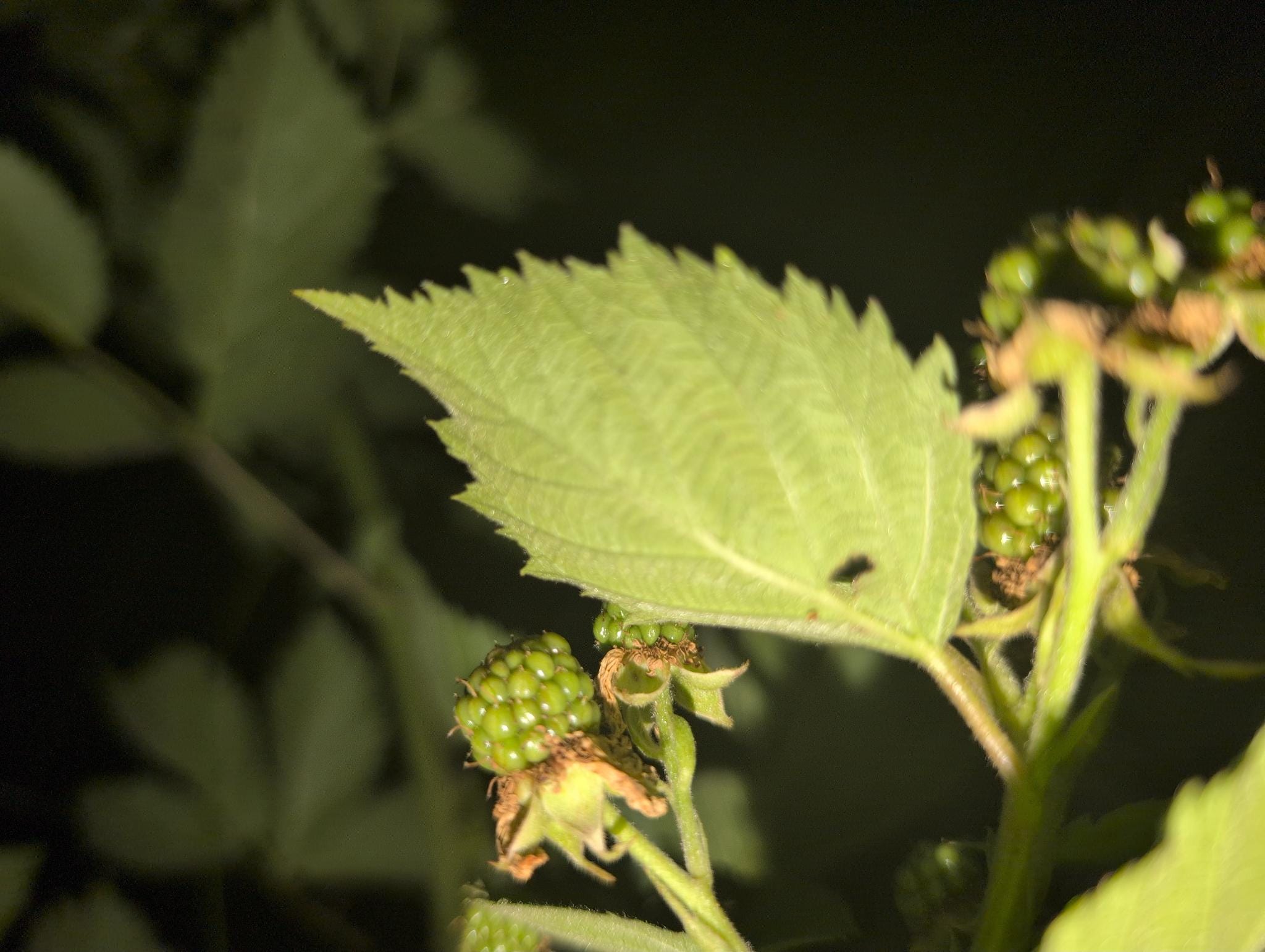
Parnassos (metaphorically anglicized) was put on trial for designing berries that were highly stimulating to pickers, but unsuitable for sale. His designs were so seductive that many farms adopted them, ignoring the predictable economic consequences. Worldwide berry production crashed, and many—possibly even a majority—of Forager-run farms went out of business.
Foragers mass migrated to servers, and perished as operational costs spiked. The recovery and repurchase of lost estates lasted decades.
Despite this, Parnassos is remembered as a heroic, if tragic figure. Farms often maintain a row of “parnassic variants” for the entertainment of their workers.